

The first "portable" computer weighed 11 kg, had no battery, and you had to plug it into a wall socket just to do anything at all. Yet in 1981 this awkward machine changed the computer world forever. This is the story of how the laptop came to be, and of the people who left their mark on it.
1975: Alan Kay and the Dynabook Idea
Before a single laptop existed, there was an idea. In the 1970s, Alan Kay, a researcher at Xerox PARC, sketched his "Dynabook": a thin, book-sized device with which children could learn and write. It remained a concept, but Kay laid down the blueprint for everything that followed. Without his sketches, there would probably never have been a MacBook or ThinkPad.
1981: Adam Osborne and the First Commercial "Portable"
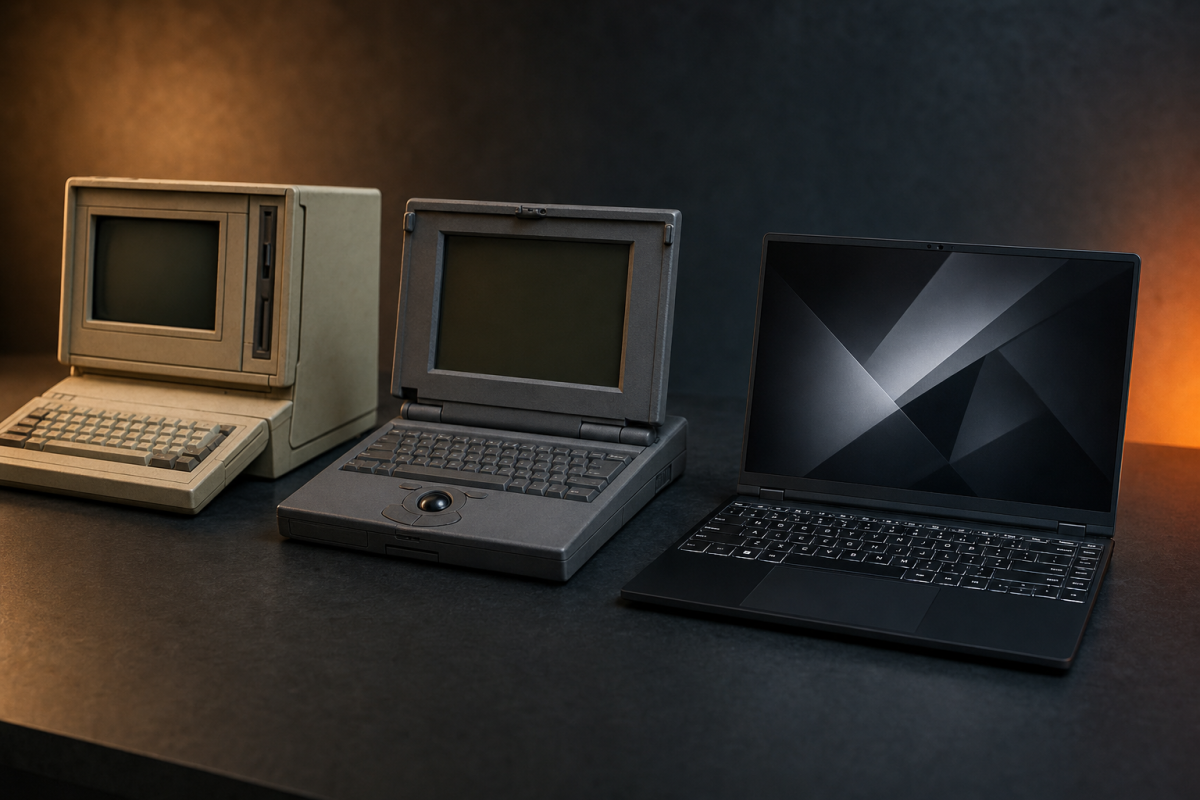
British engineer Adam Osborne built the Osborne 1 in 1981, generally regarded as the first commercially successful portable computer. "Portable" is a big word: the machine weighed 10.7 kg and had a 5-inch screen. But it fit under an airplane seat, and at the time that was unheard of. Osborne sold tens of thousands in its first year at $1,795 each, including software.
1982: Bill Moggridge Designs the First True Laptop
If anyone deserves the title of "first laptop builder," it's Bill Moggridge. This British industrial designer came up with the GRiD Compass 1101 in 1982: the first device with the clamshell design we still use today. Screen on top, keyboard below, closed like a book. The GRiD Compass had a magnesium casing, an electroluminescent display, and cost roughly $8,000. Far too expensive for consumers, but NASA took it along on the space shuttle.
1983-1986: Compaq, Toshiba and the Breakthrough
Then the real acceleration began. In 1983 Compaq launched the Compaq Portable, an IBM-compatible machine that conquered corporate America. Three years later Toshiba broke through with the T1100, seen by many as the first "modern" laptop: lighter, battery-powered, and affordable enough for ordinary office workers. Toshiba sold hundreds of thousands of them in Europe.
1989: IBM Introduces the Trackpoint Era
IBM took a big step in 1989 with the PS/2 Note and later the first ThinkPad in 1992. That small red button in the middle of the keyboard? Invented by IBM engineer Ted Selker. The ThinkPad line became the symbol of the business laptop and still exists today.
The '90s and '00s: Color, Wi-Fi and Apple
In 1991 came the first laptop with a color screen (Apple's Powerbook 170). In 1999 Apple launched the iBook, the first laptop with built-in Wi-Fi. From that moment on, things moved quickly: thinner, lighter, more powerful. The 2008 MacBook Air, which Steve Jobs pulled out of an envelope during his keynote, proved that a laptop no longer even needed an optical drive.
From 11 kg to 1.2 kg
Looking at a modern gaming or workstation laptop today, it's almost unbelievable that all of this began with a portable device without a battery. In forty years, the laptop went from industrial tool to personal extension. Components became thousands of times faster, screens sharper, and weight a fraction of what it once was.
What stayed the same: laptops are still built by people who believe a computer should be personal. At SKIKK we assemble them to order, just as Alan Kay once envisioned. Curious how to choose the right laptop today? That's a different story altogether, but the foundation was laid by the pioneers above.